
How to Tell Where a Paint by Number Kit Is Really Made (and Why It Matters)
Before starting Mitten Masterpiece, I was simply a paint-by-number customer—someone who loved the idea of slowing down, painting something beautiful, and ending up with artwork worth hanging on the wall. Like many people, I ordered kits online from well-known brands whose websites confidently stated things like “shipped from the USA.” At the time, I assumed that meant the kits were made here, or at least thoughtfully produced with quality materials.
But over time, I started to notice things that didn’t quite add up.
Orders took weeks longer than expected. Tracking numbers showed long gaps before ever reaching a U.S. carrier. Paint quality varied from kit to kit. Packaging felt generic, with little information about where anything was actually produced. None of this was dishonest on its face—but it raised an important question I hadn’t thought to ask before: where are paint-by-number kits really made, and how can customers tell?
This post isn’t about calling out brands. It’s about helping customers make informed choices, because transparency matters—especially when you’re investing time, creativity, and care into a finished piece you’re proud to display.
“Shipped From the USA” vs. “Made in the USA”
One of the most common phrases customers encounter is “shipped from the USA.” This simply means the product is mailed from a U.S. location, often a fulfillment warehouse. It does not mean the kit was manufactured, printed, or assembled in the United States.
In many cases, paint-by-number kits are mass-produced overseas, shipped in bulk to the U.S., and then distributed domestically. That’s a common and legal business model—but it’s different from domestic production, and customers deserve to understand that distinction.
If a website doesn’t clearly state where the canvas, paints, and printing are produced, it’s reasonable to assume some or all components may be manufactured abroad.
Shipping Timelines Can Tell a Story
Another subtle clue is fulfillment timing. When I first started ordering kits as a customer, I noticed that “in stock” didn’t always mean quick delivery. Orders would sit in processing for long stretches, and tracking information often showed international transit before switching to USPS or FedEx.
Long lead times, delayed tracking updates, or shipments that seem to “appear” in the U.S. after weeks can indicate overseas production pipelines. Again, this doesn’t automatically mean low quality—but it does suggest that the kit wasn’t produced locally.
Packaging Language and Transparency
Take a close look at how a kit is described once it arrives. Is there a clear country-of-origin label? Are the materials explained in detail? Or is the language vague, using phrases like “designed in the USA” without clarifying where production happens?
In my experience as a customer, the more generic the packaging and the less information provided, the less likely the brand was to be hands-on with their production process. Transparency tends to show up not just on websites, but in the product itself.
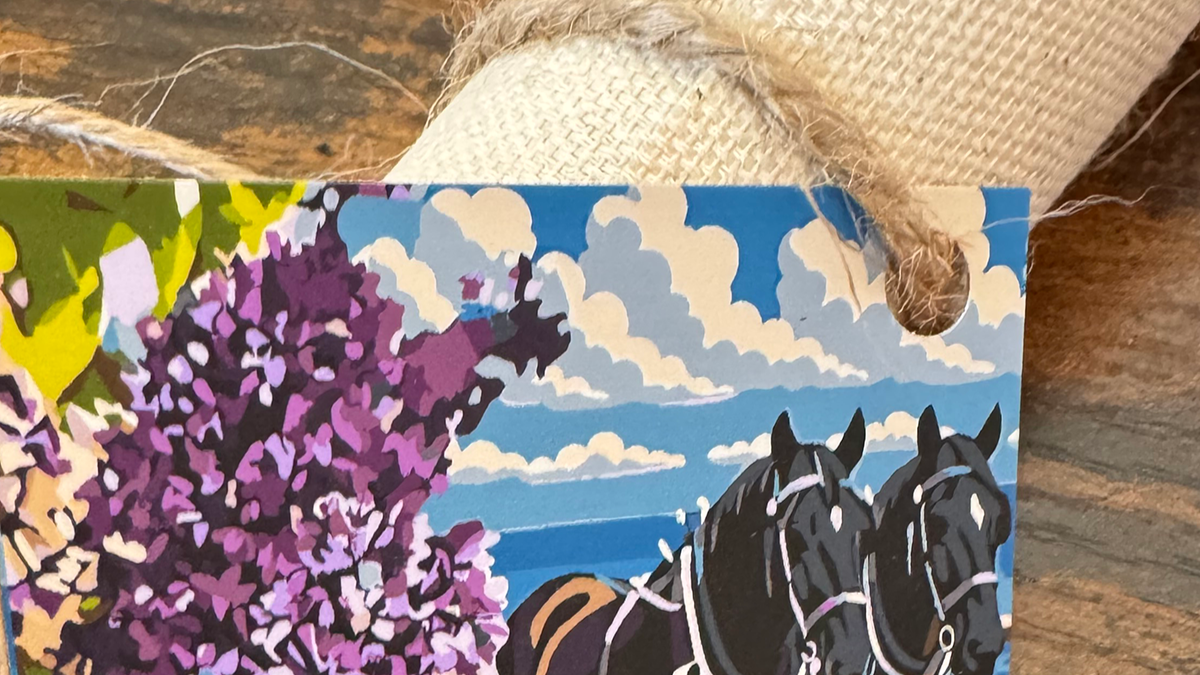
Lavender, Lilacs, and Hooves with a Rolled Canvas
Paint Quality and Consistency
This was one of the biggest turning points for me.
Some kits painted beautifully. Others required multiple coats for coverage, had inconsistent color mixing, or arrived with paints that had separated or dried unevenly. These inconsistencies are often a byproduct of large-scale, high-volume production where paint formulas are designed for efficiency rather than performance.
As a customer, I didn’t have the language for this at the time—but I felt the difference while painting.
Price vs. Materials Reality
It’s also worth being realistic about pricing. Artist-grade acrylic paints, high-quality canvas, and careful printing all come at a cost. When a kit is priced extremely low while claiming premium quality, something has to give—often material quality or production standards.
This doesn’t mean every affordable kit is poorly made. But it does mean that truly premium materials and transparent production rarely align with rock-bottom pricing.
Why Transparency Became Central to Mitten Masterpiece
My experience as a paint-by-number customer is exactly what led to Mitten Masterpiece. I wanted to know what I was painting with. I wanted consistency. I wanted a finished piece that didn’t feel disposable.
That’s why we openly share our process—from testing paints and canvases to refining designs and assembling kits. Not because every customer asks, but because they shouldn’t have to.
Knowing where a paint-by-number kit is produced helps customers understand what they’re buying, why it’s priced the way it is, and what kind of experience they can expect from the first brushstroke to the final frame on the wall.
In the end, transparency isn’t about comparison—it’s about trust. And trust is what turns a simple kit into a creative experience worth coming back to again and again.
❤️ With Love from Michigan,
Bobbie